 Add to Chrome
 Add to Firefox
 Add to Edge
ERNIE 5.0 Technical Report
Feb 04, 2026
In this report, we introduce ERNIE 5.0, a natively autoregressive foundation model desinged for unified multimodal understanding and generation across text, image, video, and audio. All modalities are trained from scratch under a unified next-group-of-tokens prediction objective, based on an ultra-sparse mixture-of-experts (MoE) architecture with modality-agnostic expert routing. To address practical challenges in large-scale deployment under diverse resource constraints, ERNIE 5.0 adopts a novel elastic training paradigm. Within a single pre-training run, the model learns a family of sub-models with varying depths, expert capacities, and routing sparsity, enabling flexible trade-offs among performance, model size, and inference latency in memory- or time-constrained scenarios. Moreover, we systematically address the challenges of scaling reinforcement learning to unified foundation models, thereby guaranteeing efficient and stable post-training under ultra-sparse MoE architectures and diverse multimodal settings. Extensive experiments demonstrate that ERNIE 5.0 achieves strong and balanced performance across multiple modalities. To the best of our knowledge, among publicly disclosed models, ERNIE 5.0 represents the first production-scale realization of a trillion-parameter unified autoregressive model that supports both multimodal understanding and generation. To facilitate further research, we present detailed visualizations of modality-agnostic expert routing in the unified model, alongside comprehensive empirical analysis of elastic training, aiming to offer profound insights to the community.

PP-YOLOE: An evolved version of YOLO
Apr 02, 2022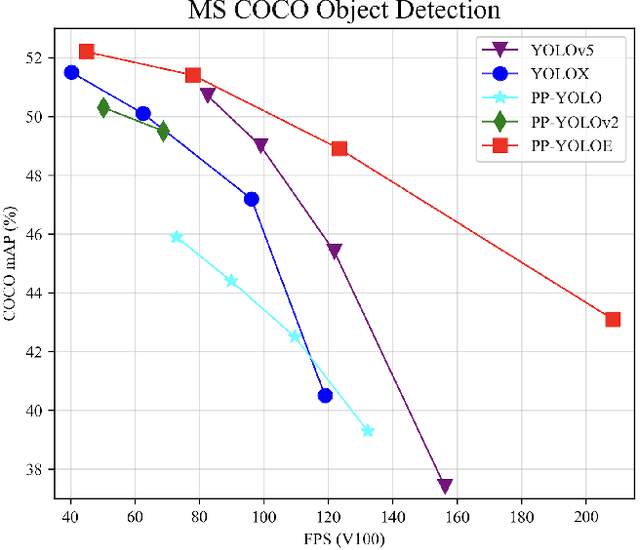
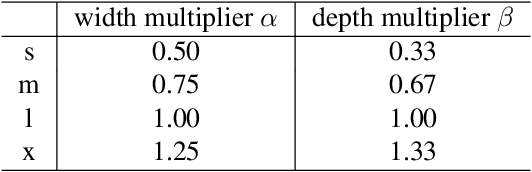
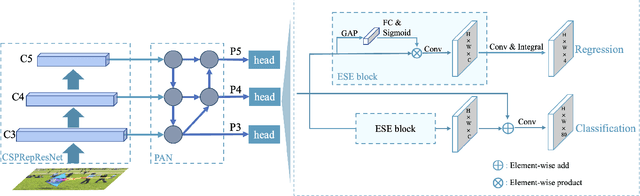

In this report, we present PP-YOLOE, an industrial state-of-the-art object detector with high performance and friendly deployment. We optimize on the basis of the previous PP-YOLOv2, using anchor-free paradigm, more powerful backbone and neck equipped with CSPRepResStage, ET-head and dynamic label assignment algorithm TAL. We provide s/m/l/x models for different practice scenarios. As a result, PP-YOLOE-l achieves 51.4 mAP on COCO test-dev and 78.1 FPS on Tesla V100, yielding a remarkable improvement of (+1.9 AP, +13.35% speed up) and (+1.3 AP, +24.96% speed up), compared to the previous state-of-the-art industrial models PP-YOLOv2 and YOLOX respectively. Further, PP-YOLOE inference speed achieves 149.2 FPS with TensorRT and FP16-precision. We also conduct extensive experiments to verify the effectiveness of our designs. Source code and pre-trained models are available at https://github.com/PaddlePaddle/PaddleDetection.
PP-PicoDet: A Better Real-Time Object Detector on Mobile Devices
Nov 01, 2021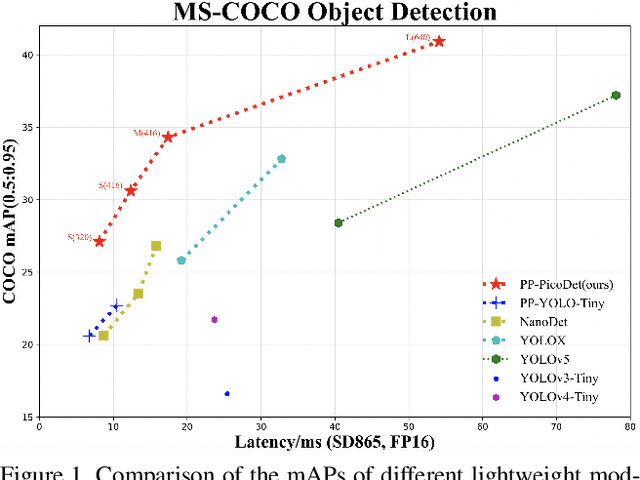
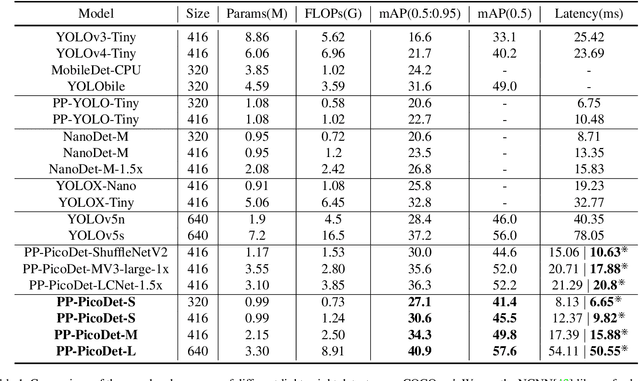
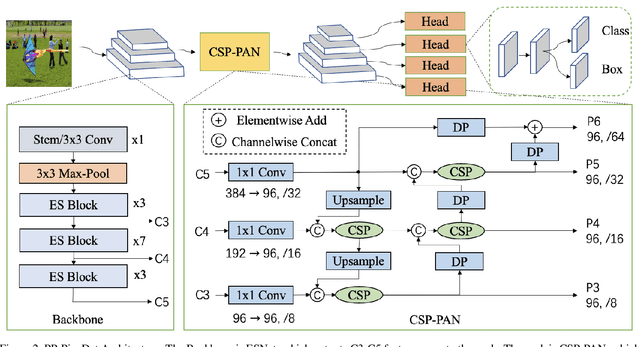
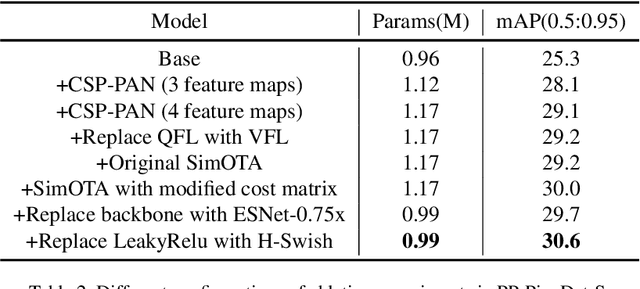
The better accuracy and efficiency trade-off has been a challenging problem in object detection. In this work, we are dedicated to studying key optimizations and neural network architecture choices for object detection to improve accuracy and efficiency. We investigate the applicability of the anchor-free strategy on lightweight object detection models. We enhance the backbone structure and design the lightweight structure of the neck, which improves the feature extraction ability of the network. We improve label assignment strategy and loss function to make training more stable and efficient. Through these optimizations, we create a new family of real-time object detectors, named PP-PicoDet, which achieves superior performance on object detection for mobile devices. Our models achieve better trade-offs between accuracy and latency compared to other popular models. PicoDet-S with only 0.99M parameters achieves 30.6% mAP, which is an absolute 4.8% improvement in mAP while reducing mobile CPU inference latency by 55% compared to YOLOX-Nano, and is an absolute 7.1% improvement in mAP compared to NanoDet. It reaches 123 FPS (150 FPS using Paddle Lite) on mobile ARM CPU when the input size is 320. PicoDet-L with only 3.3M parameters achieves 40.9% mAP, which is an absolute 3.7% improvement in mAP and 44% faster than YOLOv5s. As shown in Figure 1, our models far outperform the state-of-the-art results for lightweight object detection. Code and pre-trained models are available at https://github.com/PaddlePaddle/PaddleDetection.
PP-YOLOv2: A Practical Object Detector
Apr 21, 2021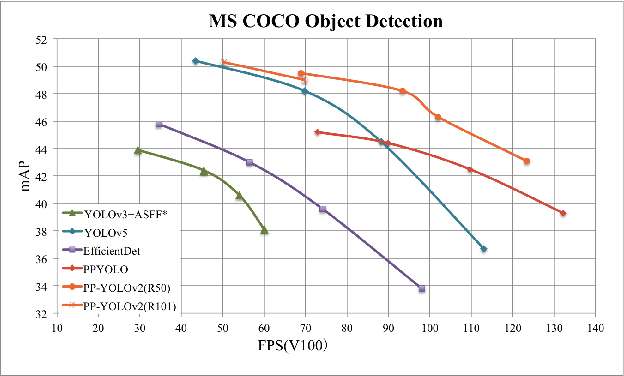

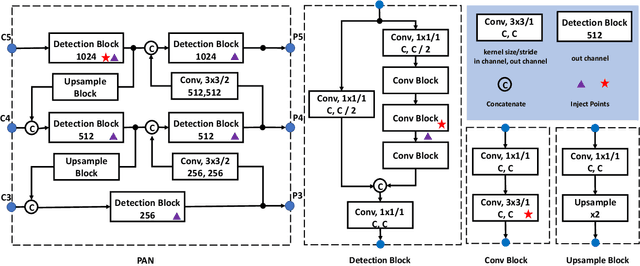
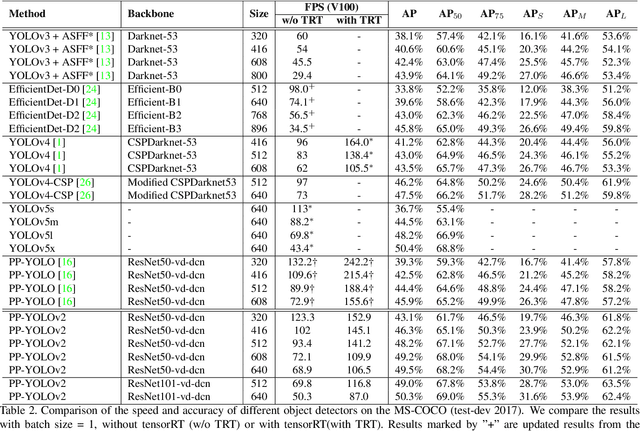
Being effective and efficient is essential to an object detector for practical use. To meet these two concerns, we comprehensively evaluate a collection of existing refinements to improve the performance of PP-YOLO while almost keep the infer time unchanged. This paper will analyze a collection of refinements and empirically evaluate their impact on the final model performance through incremental ablation study. Things we tried that didn't work will also be discussed. By combining multiple effective refinements, we boost PP-YOLO's performance from 45.9% mAP to 49.5% mAP on COCO2017 test-dev. Since a significant margin of performance has been made, we present PP-YOLOv2. In terms of speed, PP-YOLOv2 runs in 68.9FPS at 640x640 input size. Paddle inference engine with TensorRT, FP16-precision, and batch size = 1 further improves PP-YOLOv2's infer speed, which achieves 106.5 FPS. Such a performance surpasses existing object detectors with roughly the same amount of parameters (i.e., YOLOv4-CSP, YOLOv5l). Besides, PP-YOLOv2 with ResNet101 achieves 50.3% mAP on COCO2017 test-dev. Source code is at https://github.com/PaddlePaddle/PaddleDetection.
PP-YOLO: An Effective and Efficient Implementation of Object Detector
Aug 03, 2020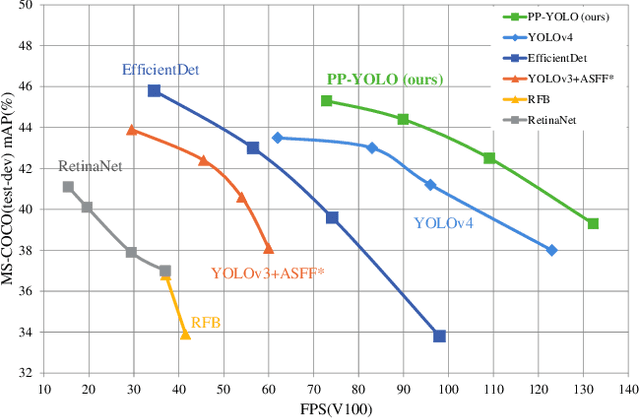
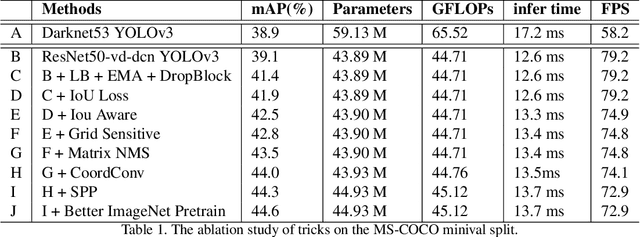
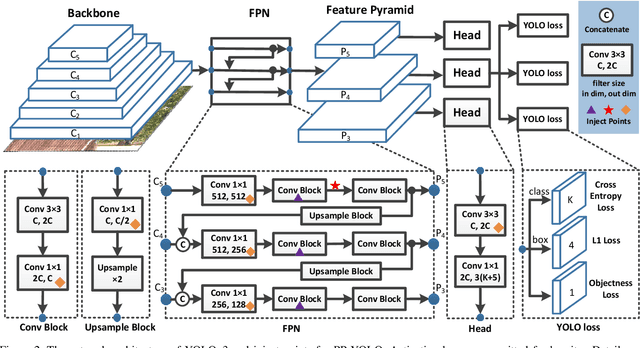
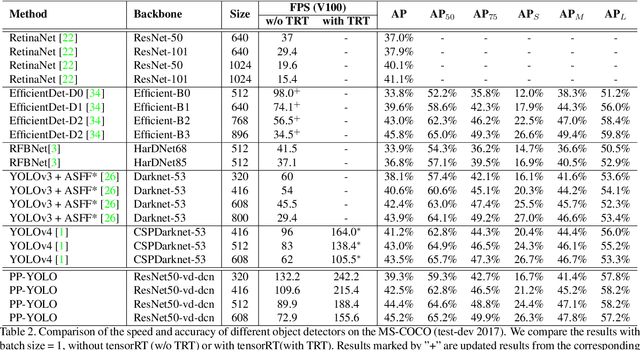
Object detection is one of the most important areas in computer vision, which plays a key role in various practical scenarios. Due to limitation of hardware, it is often necessary to sacrifice accuracy to ensure the infer speed of the detector in practice. Therefore, the balance between effectiveness and efficiency of object detector must be considered. The goal of this paper is to implement an object detector with relatively balanced effectiveness and efficiency that can be directly applied in actual application scenarios, rather than propose a novel detection model. Considering that YOLOv3 has been widely used in practice, we develop a new object detector based on YOLOv3. We mainly try to combine various existing tricks that almost not increase the number of model parameters and FLOPs, to achieve the goal of improving the accuracy of detector as much as possible while ensuring that the speed is almost unchanged. Since all experiments in this paper are conducted based on PaddlePaddle, we call it PP-YOLO. By combining multiple tricks, PP-YOLO can achieve a better balance between effectiveness (45.2% mAP) and efficiency (72.9 FPS), surpassing the existing state-of-the-art detectors such as EfficientDet and YOLOv4.Source code is at https://github.com/PaddlePaddle/PaddleDetection.